Last time I read the longevity talisman as a portable eclipse: the sun above, the crescent below, and a line of stars between them, a sky the wearer carries on the body. This time I want to look at the two red arcs that curve down on either side of the moon. They are writing.
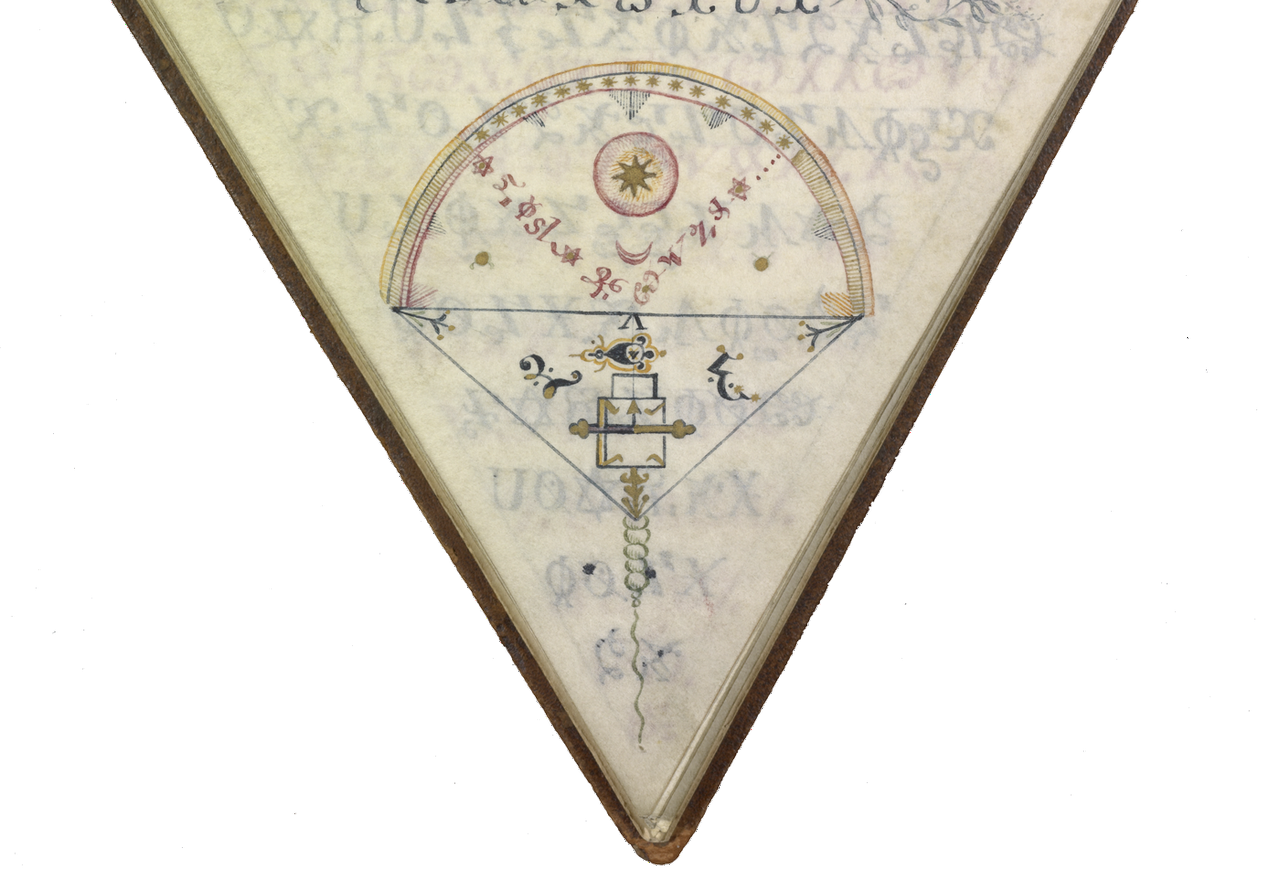
The Triangular Book makes three promises: to recover what is lost beneath the sea, to find what lies hidden in the earth, and the famous one – to prolong life to a century and beyond, with the freshness of fifty.
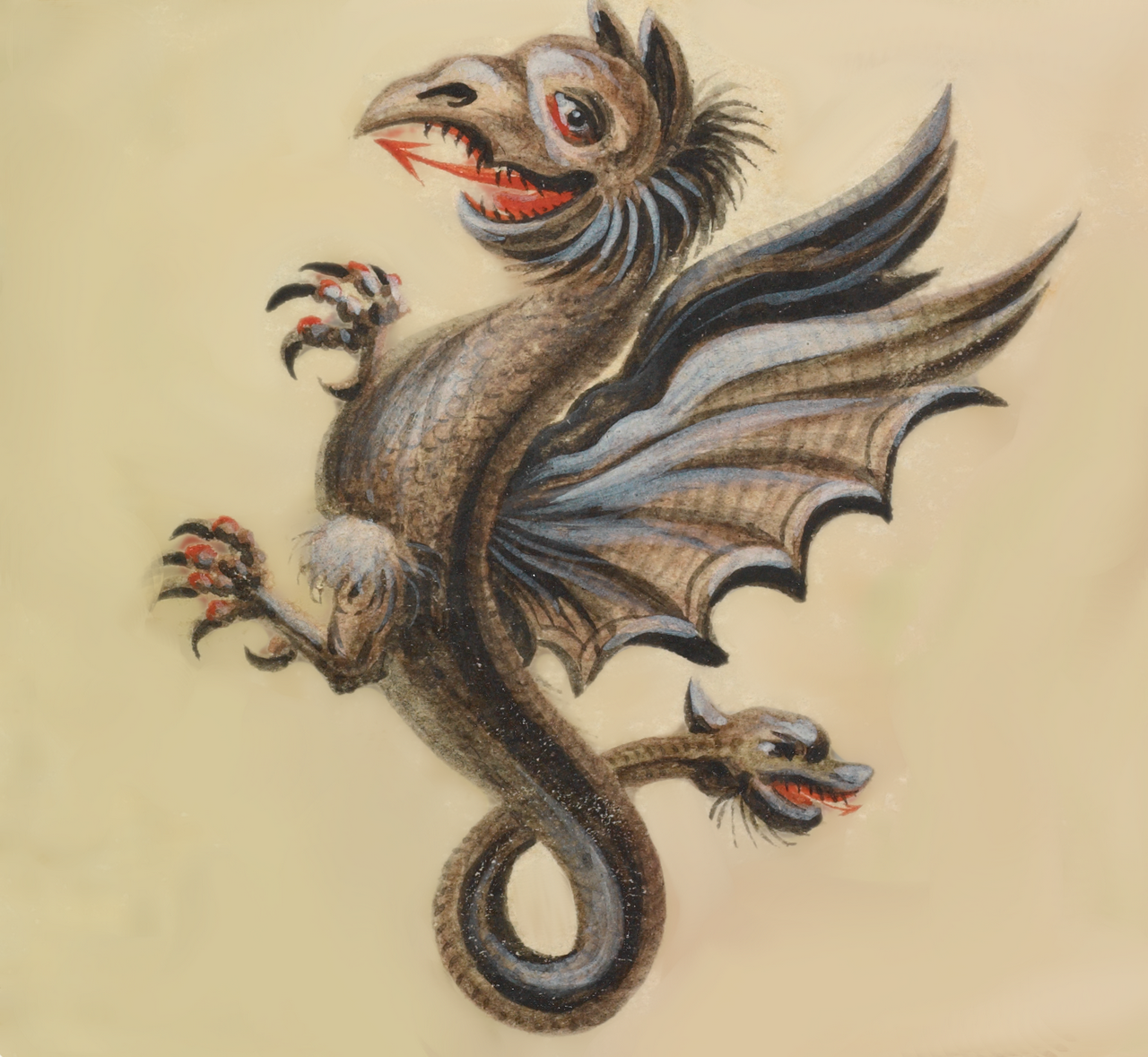
The first time I wrote about this dragon I described it like this: the snarling little face on the tail, the missing hind legs, the human eye set among the plumage. I want to come back to it, because since then the cipher has told us something the picture alone cannot. The book's first sentence does not merely show a dragon: it names it.
Before any new posts go up, a housekeeping one. This project has been running for a few years now, and the research has progressed. Some of what I wrote in the early posts is no longer accurate. Most corrections already appear as a short note next to the passage they fix, on the original post. A few had not been marked. Below is the full list, gathered in one place.
Once again, we return to the ritual circle, and more precisely, the triangle within it. As you may recall from a previous post, we see three letters in the corners (going from bottom left to top center to bottom right): V, P, T.
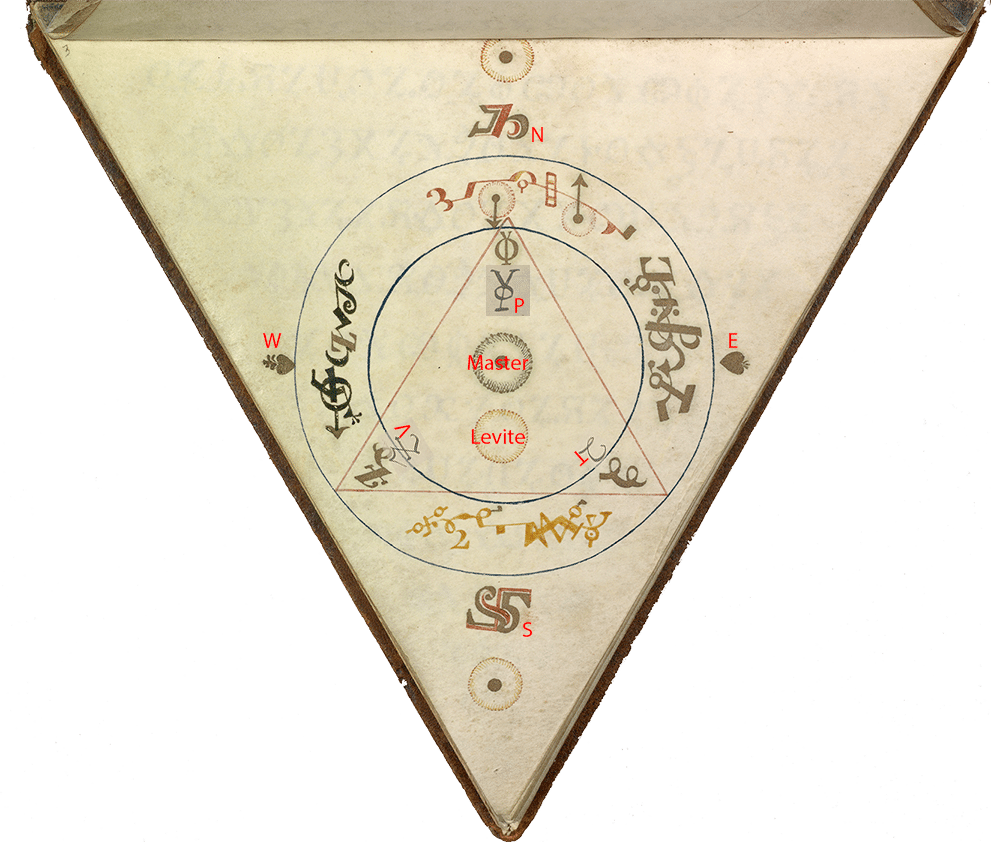
These three letters represent the key words of an alchemical concept: Vita Prima Tria, the Three Vital Principles, introduced Paracelsus in the 16th century.
Let us return to the Circle, also known as the Ritual Figure in the Triangular manuscript:
As mentioned earlier, we have an arrangement for a figure meant to be drawn on the ground during the ritual. But is there more to it?
I want to acknowledge the people who have been not only reading these musing but also providing their perspectives and insights by sending me emails. Thank you.
I read all of your correspondence with interest, even though I do not have a chance to respond to everyone. I live very far away from people. My access to the internet and other forms of telecommunication requires making a multi day trek on foot and so happens infrequently – sometimes once every few months.
Much more remains to be said on the subjects of longevity, ancient mysteries, and magic. Keep in touch.
The big promise of magic, especially that attributed to the Count of St. Germain, is longevity or even immortality. While the spirits insist that true immortality is out of reach to humans “by design,” the possibility of life extension by hundreds or even thousands of years exists.

Following the enigmatic introduction, there is an illustration of a dragon, a most unusual and curious example of this creature. It has a small snarling face on its tail, a lack of hind legs, and its posture suggests a Lion rampant rather than the typical fire-breathing wyrm.

Its tongue has a triangle tip, it has distinct five claws of a Japanese vs. Chinese dragon, and amidst its colored plumage can be seen a remarkably well-painted human eye.
Longevity is the key secret of the Count of St. Germain. Centuries of time have dimmed the other, lesser known legends of his immense knowledge, wealth, and mysterious origin. So what did the Count recommend to all those who sought this precious gift of long life? It was the following recipe, presented clearly for the first time in nearly 300 hundred years.
