The Winged Dragon, revisited
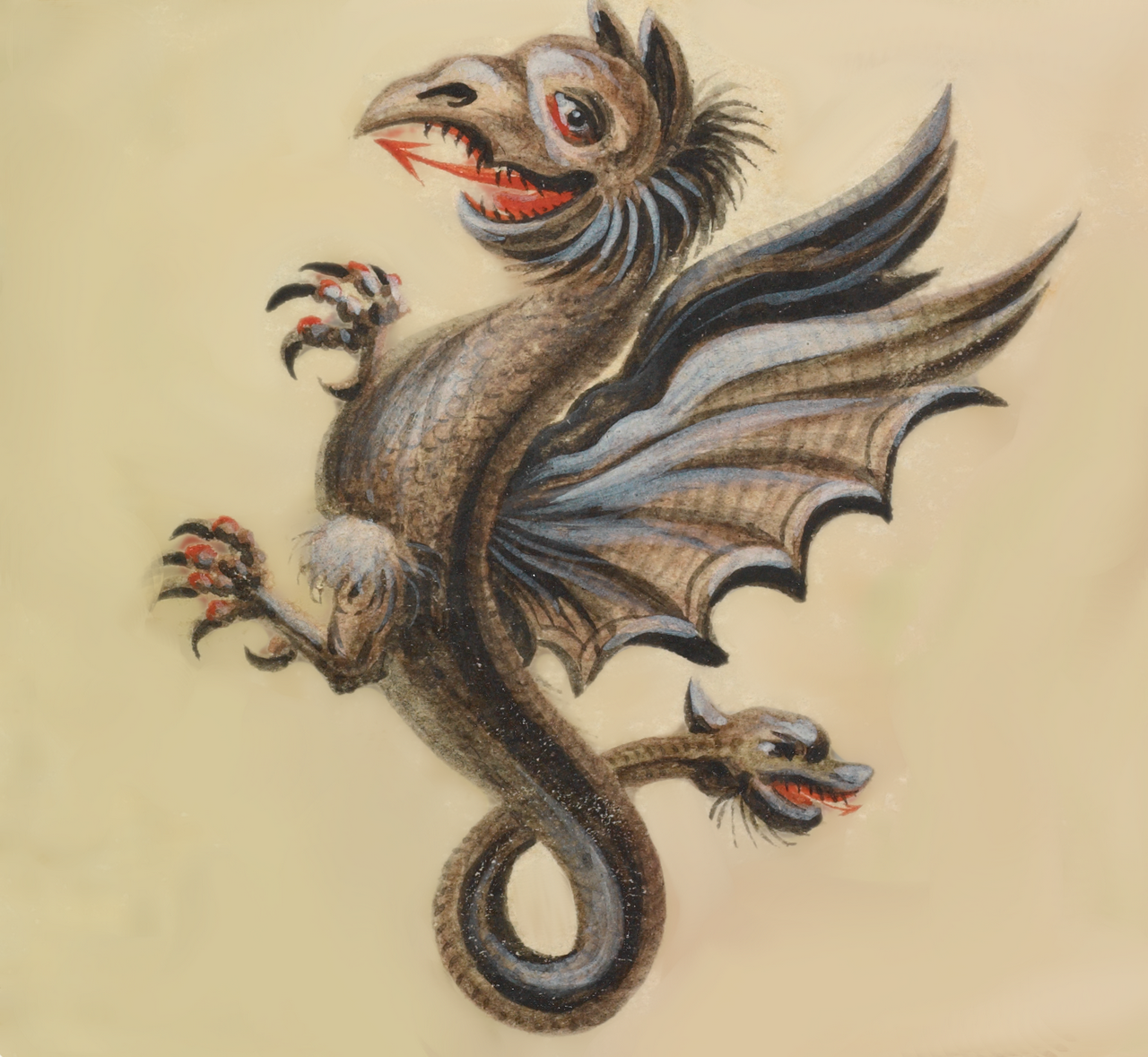
The first time I wrote about this dragon I described it like this: the snarling little face on the tail, the missing hind legs, the human eye set among the plumage. I want to come back to it, because since then the cipher has told us something the picture alone cannot. The book's first sentence does not merely show a dragon: it names it.
Deciphered, that sentence reads: La Magie Sainte, révélée à Moyse, retrouvée dans un monument Egyptien & précieusement conservée en Asie sous la devise d'un dragon ailé — “Holy Magic, revealed to Moses, found in an Egyptian monument, and carefully preserved in Asia under the device of a winged dragon.” The word is devise: a device, an emblem, a badge. The creature on the front is the book's own coat of arms.
Where would a French author of the period get the idea of an Asian magic kept “under the device of a winged dragon”? He would get it in print. In 1735 the Jesuit Du Halde, in the standard French account of China, calls the imperial Chinese dragon la devise de la Chine (“the device of China”) and explains that only the emperor may draw it with five claws; everyone below him is held to four, on pain of punishment. Two years later a French flag-book, La Connoissance des pavillons (1737), pictures the emperor's own banner and blazons the beast on it:
Il est jaune, chargé d'un Dragon de sable, à la queuë de Basilic de même, à cinq Griffes à chaque patte, & la tête tournée en dehors — “It is yellow, charged with a dragon sable, with a basilisk's tail, five claws on each foot, and its head turned outward.”
Now read that caption with our dragon in front of you. It carries five claws on each foot (in the finer of the two copies), its head is turned outward, and the whole thing is offered, in the book's own word, as a devise. The banner even gives its dragon “a basilisk's tail,” and ours ends in that strange second little face. The vocabulary of the emperor's dragon is sitting on the title page of a French grimoire.
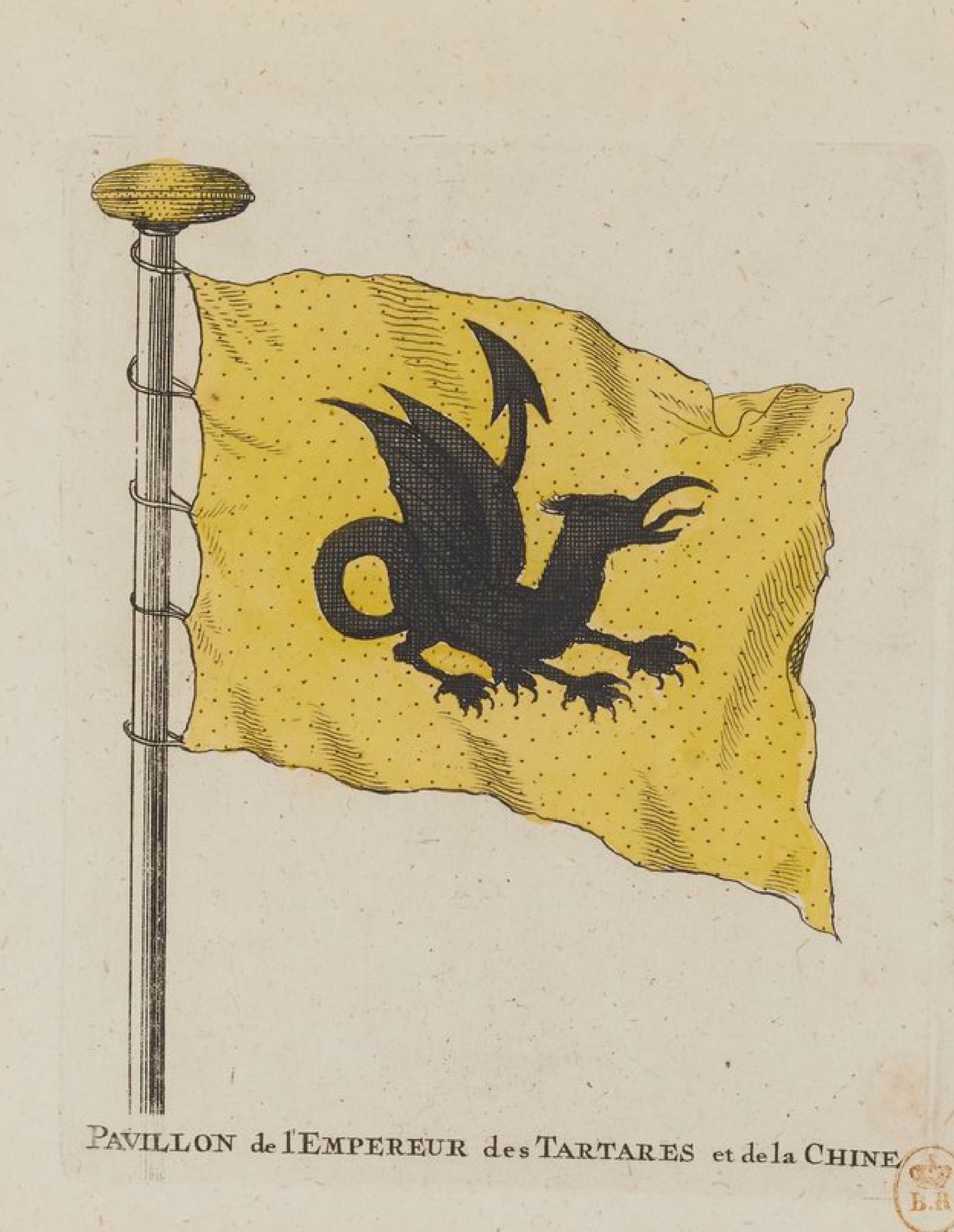
And then you look at the flag itself... and the comparison spell breaks. The engraved dragon on the banner is a plain four-legged creature with a single curled tail. It looks little like ours, which has no hind legs at all, bat wings, and a body built to a European heraldic pattern. So the book did not copy the picture. But it copied the words. Its author drew an ordinary European wyvern and dressed it in the Chinese emperor's blazon: the five claws, the turned head, the devise of Asia, lifted off the page and painted onto a creature that was never Chinese to begin with.
That leaves one unexplained feature. Among the coloured feathers sits a human eye, modelled like a portrait miniature. Another animal on the same leaf was given an ordinary round eye, so this was no accident. French heraldry even has a name for the type, a dragon à face humaine (“a dragon with a human face”). The badge is borrowed. The eye looking out of it is the painter's own.