The Longevity Figure, part two: the book signs its own names
Last time I read the longevity talisman as a portable eclipse: the sun above, the crescent below, and a line of stars between them, a sky the wearer carries on the body. This time I want to look at the two red arcs that curve down on either side of the moon. They are writing.
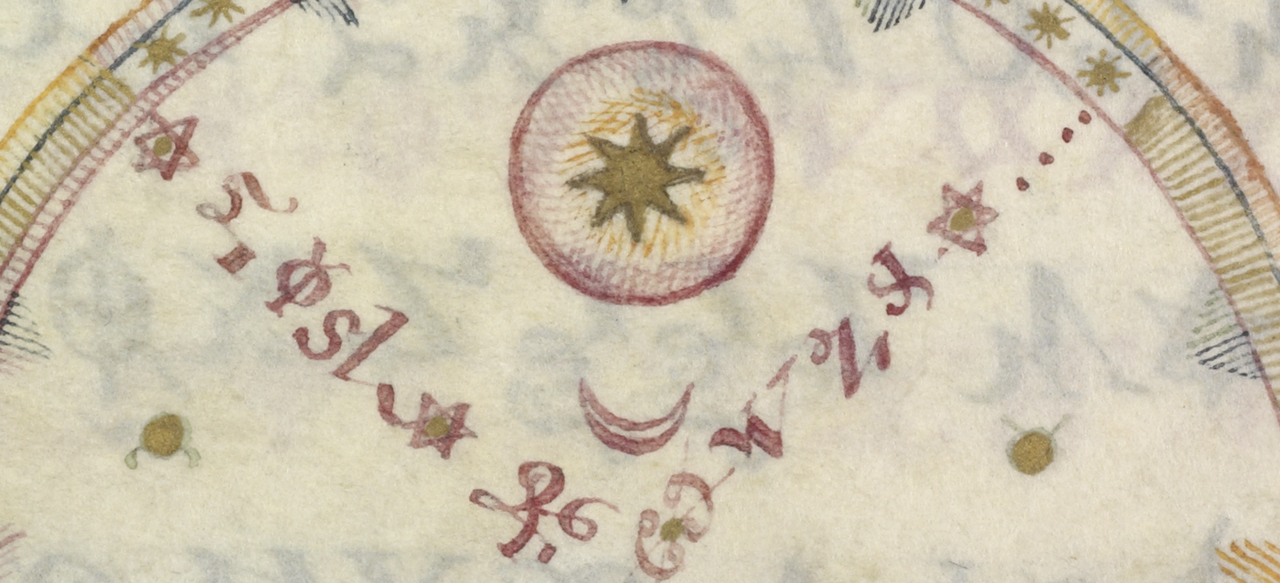
Look first at the letters. They are all the book's cipher characters, the same ones that fill its pages. The six-pointed star is A, and the sign that looks like a Greek phi is P. That P also tells us these are words spelled out in full, because a Greek alpha or omega has no P in it.
Read the left arc from the rim inward and it spells ALPHA. After the last A comes a little knot of crossed loops with a separate curl above it. That is the scribe's sign for et (“and”), the ampersand from the cipher key, and it sits between the names of spirits in the running text in the same form.
The right arc opens with a short trail of dots and then reads AGEMO, which is OMEGA written backwards. One small mark in the middle is faint, so I hold this reading a little less firmly than the left one. Still, no other word fits the letters.
AGEMO is how the book itself writes the name. In the blessing of the circle, where the text calls on the holy names one by one, OMEGA appears as AGEMO and ALPHA as APHAL, its letters shuffled. I wrote about this habit in an earlier post: the author was not content with the cipher alone and reversed or scrambled the sacred names on top of it. On the talisman the same hand writes ALPHA straight and OMEGA backwards. I do not know why the two arcs differ. The spirit names get the same treatment, and they will have a series of their own later.
Alpha and Omega, the first letter and the last. In Revelation it is a divine title, given in the first chapter and again in the last, and the Heptameron, which the Triangular Book seems to build on, has Alpha et Omega (“Alpha and Omega”) in the formula our book adapts for its blessing. The scriptural reading is the obvious one.
I have a second reading, and I offer it only as a suggestion. This figure draws an eclipse, and an eclipse has two ends of its own. The moon's path crosses the sun's at two points, the nodes, and an eclipse can only fall near one of them. French astronomers of the period called them la Tête du Dragon and la Queue du Dragon (“the Head of the Dragon” and “the Tail of the Dragon”). The book opens with its emblem, a winged dragon with a second small face at the end of its tail. On a figure of an eclipse, in a book badged with that dragon, the beginning and the end may also be the dragon's head and tail.
Next time: the three small gold letters at the foot of the figure. Two of them are clear. The middle one still has no agreed reading.